
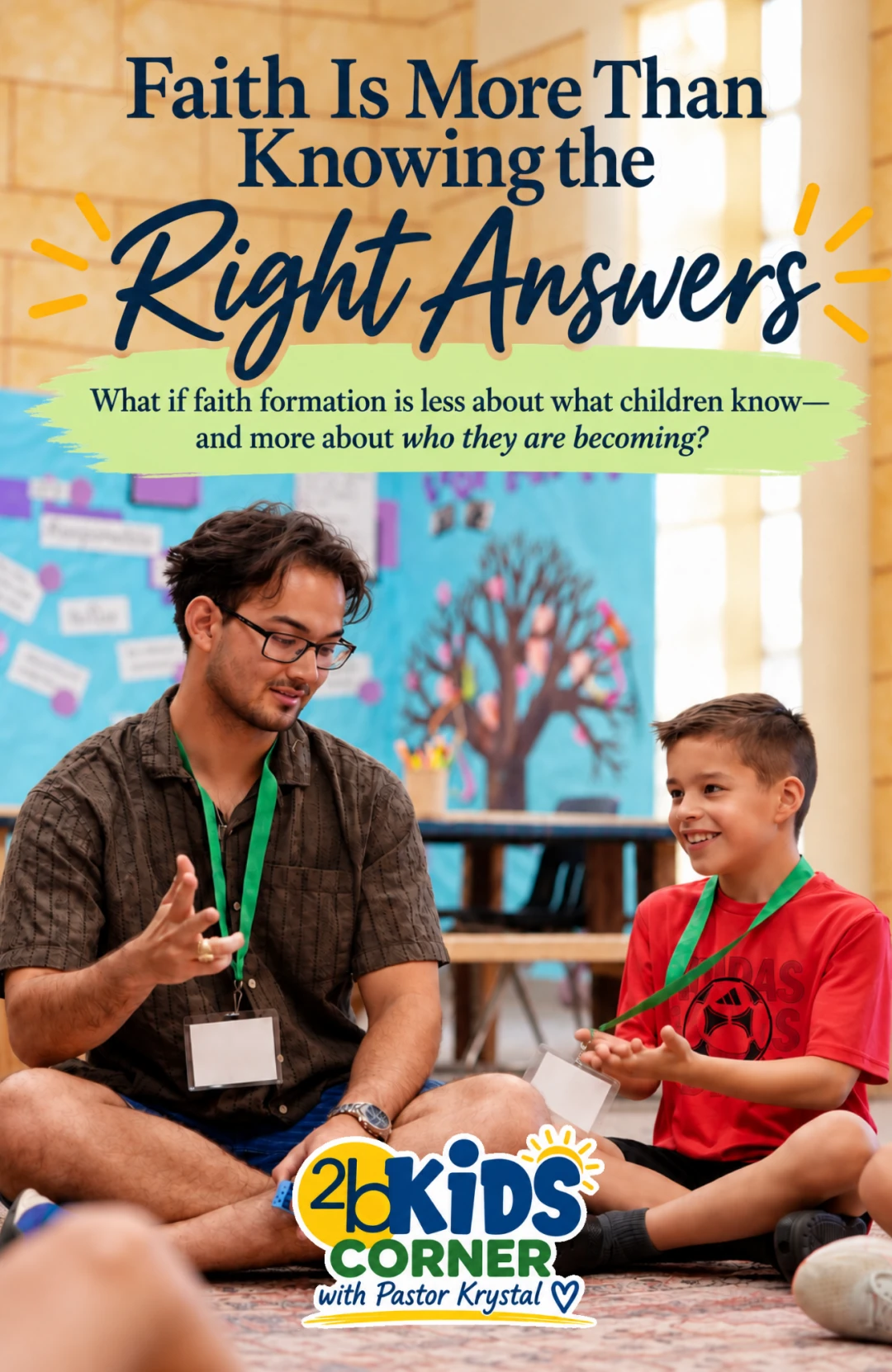
Spend enough time in a Sunday School classroom and eventually you will see it happen. You ask a question, a hand shoots into the air, and a child confidently answers, “Jesus!”
Sometimes Jesus actually is the answer. Sometimes Jesus has absolutely nothing to do with the question. Either way, kids learn pretty quickly that church has certain “right answers.” God. Jesus. Love everybody. Pray. Read your Bible. Be kind.
And none of those are bad answers. In fact, I hope our children learn a lot about their faith. I hope they know the stories of Scripture and become familiar with the words we use in worship. I hope they learn prayers and traditions and begin to understand the beliefs and practices that have shaped Christians for generations. Teaching our children the stories of our faith matters.
But knowing the right answers is not the same thing as having a growing faith. Sometimes, without meaning to, we can approach faith formation like any other subject children need to learn. We tell a Bible story, teach the lesson, ask a few questions, and hope that by the end they can tell us what they learned. There are plenty of things we can easily measure that way. Who built the ark? What did David use to fight Goliath? How many disciples did Jesus have? A child either remembers the answer or they don't.
The problem is that some of the most important things happening in a child's faith can't be measured nearly as easily. We can't give a quiz to find out whether a child is becoming more compassionate. There isn't a worksheet that tells us whether they are beginning to notice people who are left out. We can't measure wonder, generosity, courage, or a growing sense that every person they encounter is deeply loved by God.
So perhaps alongside the question, “What are our children learning?” we should also be asking, “Who are our children becoming?”
Are they becoming people who notice when someone is sitting alone? Are they learning to be curious about God and discovering that difficult questions are welcome? Are they beginning to recognize when something isn't fair? Are they learning to care for creation, share what they have, forgive, speak up, and make room for others? Are they beginning to understand not only that there is a place for them at God's table, but that there is a place for everyone else there, too?
These things may be harder to measure, but they are every bit as much a part of faith formation as learning a Bible story.
Jesus certainly taught people. The Gospels are full of stories, questions, parables, and conversations in which Jesus helped people understand God and God's kingdom in new ways. But when Jesus gathered disciples, the invitation wasn't simply to come and learn the right information. The invitation was, “Follow me.”
Following Jesus meant learning a different way to move through the world. The disciples watched Jesus eat with people others avoided, notice people everyone else walked past, welcome children, share food, forgive, challenge injustice, and extend compassion in unexpected places. They learned by listening to Jesus, but they also learned by walking alongside Jesus and practicing this way of life themselves. Faith was never meant to live only in their heads.
The same is true for our children. When we start looking at faith this way, we begin to notice faith formation happening in places we might otherwise miss. It happens when a preschooler scoots over to make room for another child at the table. It happens when a second grader asks a question about God that leaves every adult in the room scrambling for an answer. It happens when a fourth grader realizes that something isn't fair and asks, “What can we do about it?” It happens when children collect food for neighbors who are hungry, stop what they're doing to marvel at something in creation, or begin to recognize that they have the ability to make someone else's day a little better.
It also happens every time a child discovers that church is a place where people know their name, listen to their questions, take their ideas seriously, and are genuinely glad they showed up. Those moments count. They may not always look like what we traditionally think of as “learning about God,” but they are helping children discover what a life with God can look like.
I think there is some freedom in that for adults, too. Parents, grandparents, teachers, and other caring adults don't have to turn every car ride or dinner conversation into a Bible lesson. We don't need to have the perfect theological response when a child asks a difficult question. Sometimes the most meaningful faith conversations begin with much simpler questions: What did you notice today? Who might need a friend? Why do you think that bothered you? What could we do to help? Where did you see something beautiful today?
And sometimes the most faithful response we can give a child is simply, “I don't know. What do you think?”
Questions like these don't always lead to neat answers, but that may be part of their value. They invite children to pay attention—to God, to themselves, to their neighbors, and to the world around them. Over time, those small moments of noticing, questioning, wondering, and practicing begin to shape the people they are becoming.
I hope our children learn the stories of our faith. I hope Scripture becomes familiar to them. I hope they know the songs, prayers, traditions, and stories that remind them they are part of something much bigger than themselves. There is tremendous value in giving children a strong foundation for understanding their faith.
But I also hope we remember that the goal isn't simply to raise children who know all the right answers. We are helping children learn what it means to follow Jesus—to become people who love deeply, wonder freely, notice their neighbors, seek justice, offer compassion, and recognize God's presence in the world around them.
And that kind of faith can't always be measured by what a child can tell us at the end of a Sunday School lesson. Sometimes we see it most clearly in who they are becoming.