
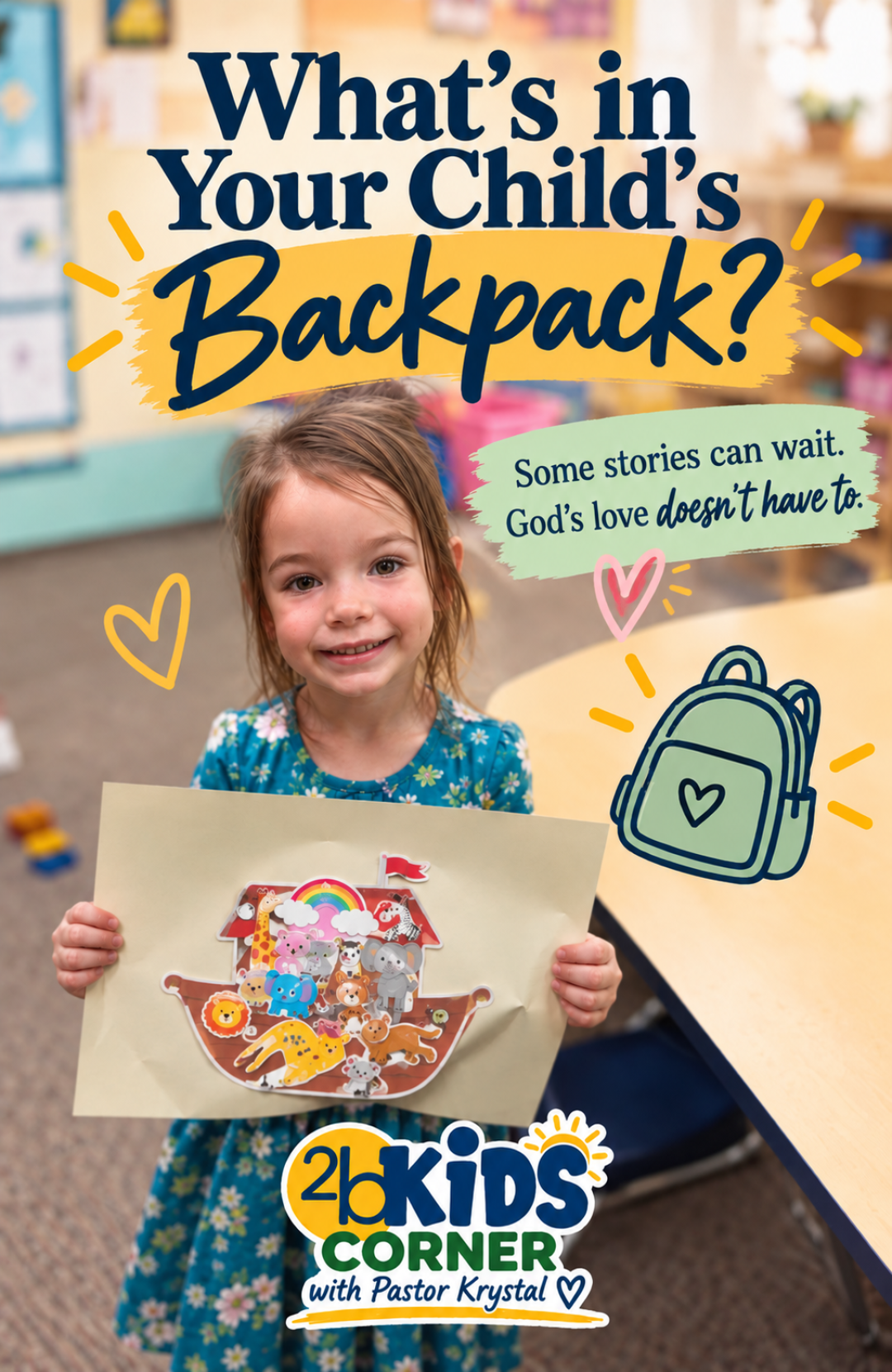
We don't have to tell children the whole story to tell them a true story.
I wonder how many of us are still unpacking things we learned about God as children.
Maybe you grew up believing that God was watching your every move, keeping track of every mistake. Maybe you were taught that good Christians don't question what the Bible says. Or perhaps there was a Bible story you heard a hundred times as a child, only to revisit it as an adult and think, "Wait a minute. That's not how I remember it!"
Some of those early lessons have stayed with us in wonderful ways. Others we've had to reconsider or rethink. And, if we're being truthful, most of us are probably still figuring some of it out.
That's not necessarily a bad thing. After all, I hope my understanding of God at thirty-five is a little different from what it was at five. I've had thirty more years of living, learning, questioning, and encountering God in new ways.
But all of this has me thinking about the children we're raising and teaching today.
Recently, I listened to an episode of the Kindred Podcast featuring Jessie Townsend, who used the image of a backpack to talk about what we teach children about faith. And I haven't been able to get that image out of my head.
Think about it. When we send children off to school, we help them pack their backpacks with the things they'll need for the day. A lunchbox, a water bottle, a folder, maybe a favorite little something tucked away in a pocket.
We don't send a kindergartner to school carrying everything they'll need through high school. That would be ridiculous! Not to mention, they'd never make it through the front door.
And yet, sometimes I wonder if we approach teaching children about God a little differently.
We want them to know the Bible. We want them to understand who God is. We want them to grow up with a faith that will stay with them long after they've left our Sunday School classrooms.
Those are good things to want.
But perhaps the question isn't how much we can fit into their backpacks. Perhaps it's whether what we're giving them is something they're ready to carry.
The Bible Is Not a Children's Book
Now, here's something you might not expect to hear from a children's pastor: The Bible is not a children's book.
I know. Strange thing for someone who spends a good portion of her week teaching children Bible stories to say.
But it's true!
The Bible is a collection of ancient writings, written by different people, in different places, across hundreds of years. It contains poetry, history, wisdom, letters, and stories that have shaped the faith of generations.
It also contains war, violence, betrayal, abuse, and some pretty complicated ideas about God.
There are passages that make even the most seasoned biblical scholars scratch their heads. So why do we sometimes feel like we need to explain all of them to a seven-year-old?
I've been reading Meredith Miller's book Wonder: 52 Conversations to Help Kids Fall in Love with Scripture, and she makes a distinction I think is incredibly important.
There's a difference between making a Bible story accessible to children and changing it so much that it no longer communicates what the story was actually about.
Miller calls that second approach "kidifying."
And here's where I think she offers us something particularly helpful: We don't have to tell children the whole story to tell them a true story.
A few weeks ago, I taught our preschoolers the story of Noah's Ark.
Now, if you've read the story of Noah lately, you know it's not exactly the cheerful little animal story we often see painted on nursery walls. There's a flood that destroys nearly all life on earth. There are difficult questions about God's judgment and the suffering of creation. There is a lot going on in those chapters of Genesis.
But our preschoolers are three and four years old.
So we talked about Noah, his family, and the animals. We talked about God's care for them, and we spent time exploring the rainbow and God's promise to creation.
We didn't talk about the destruction of humanity. We didn't wrestle with the theological implications of divine judgment. Those aren't conversations our preschoolers need to have right now.
But here's the important part: We didn't have to change the story to talk about God's promise. That promise is really there. It's part of what the story is communicating.
And someday, when those children are older, they'll encounter Noah's story again. They'll notice things they didn't notice before. They'll ask questions they weren't ready to ask at four years old. They might even struggle with parts of the story.
And that's okay.
What they learned as preschoolers can still be true, even as their understanding of the story becomes more complicated.
That's what it means to make Scripture accessible without losing its meaning.
There's No Rush
The more I think about this, the more I realize that we already understand this concept in other areas of church life.
Think about Christmas and Easter.
Every year, we return to those same familiar stories. We don't tell the Christmas story once when a child is four and then check it off the list. We come back to it again and again.
A preschooler might hear about Mary and Joseph traveling to Bethlehem and the birth of baby Jesus. A few years later, that same child might begin wondering why Jesus was born in a stable instead of a palace. As a teenager, they might explore the political world into which Jesus was born and what it meant for God to enter the world in such an unexpected way.
It's the same story. But the questions change as we change.
The same is true of Lent and Easter. Our youngest children can begin exploring God's love and the hope of resurrection. As they grow, there will be opportunities to talk about suffering, injustice, the crucifixion, and what it means to follow a Jesus who challenged the powers of the world.
We don't have to explain everything the first time around.
And we don't have to be afraid of coming back to a familiar story with new questions.
In fact, I think that's part of what makes the Bible so remarkable. We can spend our whole lives returning to these ancient stories and still discover something we hadn't noticed before.
Miller encourages parents and teachers to consider whether what we're sharing with children today will remain faithful to the story when they're ready to explore more of it later.
And when we can't find a way to do that? Sometimes we can simply save that story for another day.
Not because the story is unimportant. Not because we're trying to hide difficult parts of Scripture. But because there is a time and a place for certain conversations, and childhood doesn't have to include all of them.
There is plenty of Scripture for children to explore right now. And there will still be plenty waiting for them as they grow.
So, What's in the Backpack?
I want to come back to Jessie's backpack for a moment.
Because I don't want you to hear all of this and think you now have one more thing to worry about getting wrong as a parent or Sunday School teacher.
Goodness knows, we have enough of those worries already.
The point isn't that every conversation about God needs to be perfectly planned or that one poorly explained Bible story is going to ruin a child's faith.
The point is that we have an incredible opportunity to help children discover who God is, and we can be thoughtful about how we do that.
We can help them carry the knowledge that they are deeply loved by God. That they are created in God's image. That their questions are welcome. That following Jesus means loving our neighbors, caring for others, and working toward a world that looks a little more like God's dream for creation.
We can teach them that the Bible is worth reading, worth questioning, and worth returning to throughout their lives.
And we can show them that faith doesn't require having everything figured out.
Because, really, how many of us have everything figured out?
I'm a pastor with a seminary degree, and I still encounter passages that leave me with more questions than answers. I still find myself reconsidering things I thought I understood about God. I still discover new meaning in stories I've heard my entire life.
I hope I never stop.
And I hope the children in our church never stop, either.
I don't want them to grow up believing that faith means knowing all the right answers. I want them to know that faith is something they can continue exploring, questioning, and experiencing throughout their lives.
I want them to feel free to come back to a familiar story and say, "I wonder if there's more to this than I thought."
And I want them to know that the adults who love them will welcome that conversation.
So maybe the next time we read a Bible story with a child, we can ask ourselves a few simple questions.
What is this story really about? What part of it can this child meaningfully engage with today? And will what we're sharing still be true when they're ready to discover more?
We won't always get it exactly right. And that's okay. We're learning, too.
The good news is that we have years of conversations, questions, discoveries, and experiences of God ahead of us.
We don't have to pack everything today.
We can give our children something true and meaningful to carry now, trusting that there will be plenty of opportunities to return, wonder, and discover more along the way.
And perhaps that's something worth carrying in our own backpacks, too.
Resources for Parents and Teachers
If you're wondering how to choose Bible stories and share them in ways that are faithful to Scripture and appropriate for children, here are a few resources I recommend.
The Book of Belonging: Bible Stories for Kind and Contemplative Kids — Mariko Clark
A beautifully illustrated collection of Bible stories emphasizing God's love, belonging, and compassion. A wonderful option for families looking to introduce Scripture through thoughtful storytelling that welcomes curiosity and wonder.
Wonder: 52 Conversations to Help Kids Fall in Love with Scripture — Meredith Miller
This is the book that inspired much of my thinking for this article. Miller helps parents and teachers approach Scripture with curiosity, consider which stories are appropriate for children, and navigate the difference between making Scripture accessible and changing its meaning.
The Peace Table: A Storybook Bible — Shine Curriculum
A storybook Bible emphasizing peace, justice, community, and God's presence in the world. It includes wondering questions and opportunities for conversation, encouraging children and adults to explore Scripture together.
The Spark Story Bible — Sparkhouse
An illustrated story Bible especially accessible to younger children. Its colorful illustrations and engaging retellings help introduce children to familiar biblical stories in ways that invite participation and conversation.
No resource is perfect, and no children's Bible can capture every dimension of Scripture. But these can be helpful companions as we decide what stories to share, how to tell them, and when to leave room for more.
This article was inspired by Jessie Townsend's conversation on the Kindred Podcast, "Progressive Christianity: What Do We Teach Our Kids?", and Meredith Miller's Wonder: 52 Conversations to Help Kids Fall in Love with Scripture, particularly her discussion of kid-accessible storytelling and saving stories for later (pages 49–52).